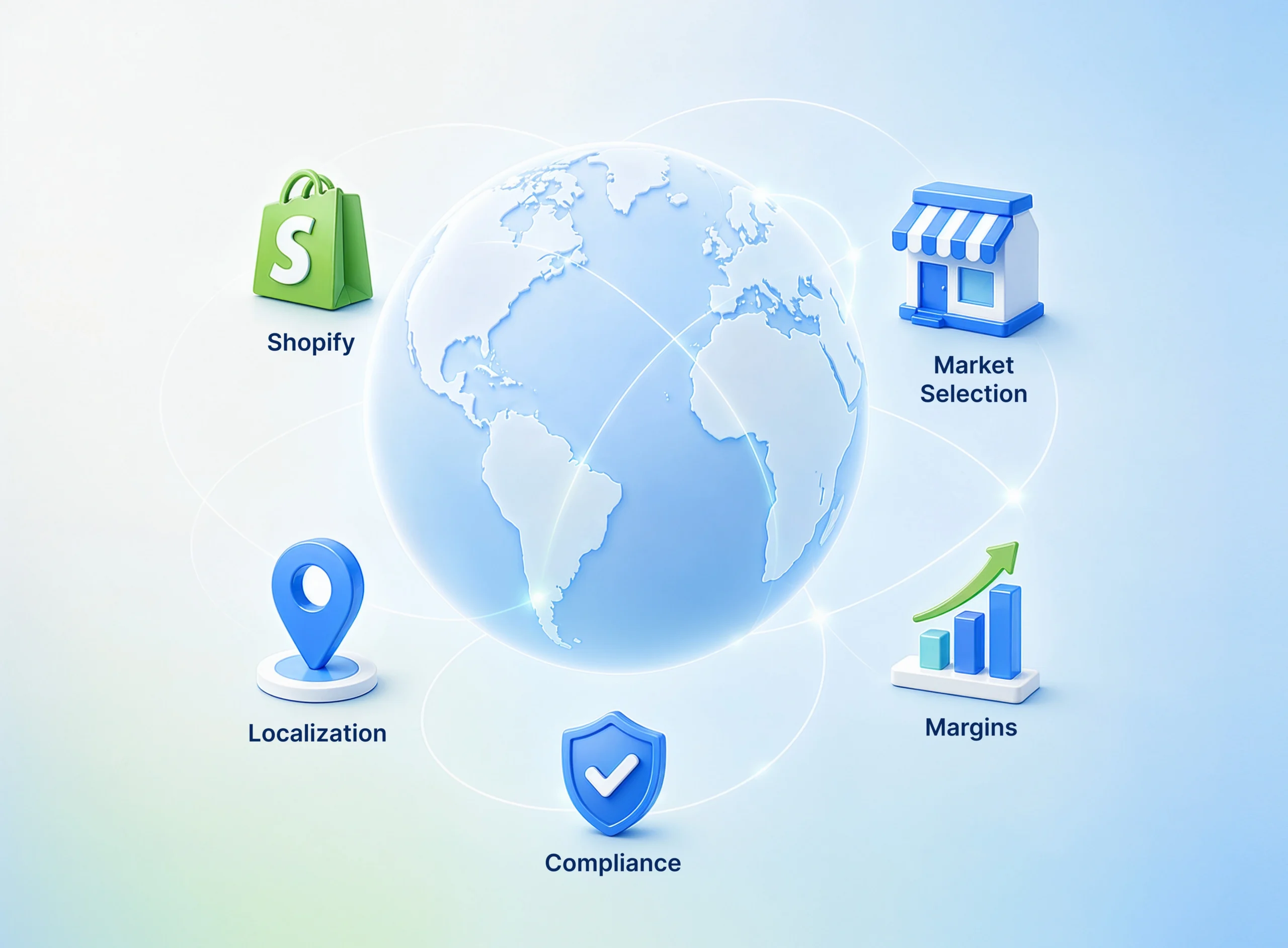

Going Global on Shopify? Read This Before You Expand Internationally
International expansion is one of the biggest growth opportunities for modern eCommerce brands.
But going global on Shopify is not as simple as enabling international shipping and hoping customers convert.
The brands succeeding internationally are not just translating their storefronts. They are building localized shopping experiences, optimizing operational infrastructure, understanding regional buying behaviors, and protecting profitability market by market.
We’ve seen brands scale globally successfully.
We’ve also seen brands expand too quickly, lose margin on shipping, create tax compliance problems, and struggle with fragmented operations.
If you’re planning international expansion on Shopify, here is what actually matters.
Start With Market Selection, Not Global Availability
One of the most common mistakes brands make is trying to launch everywhere at once.
International growth works best when expansion is intentional.
Before launching in a new market, analyze:
- Existing international traffic in GA4
- Conversion rates by country
- Organic search demand
- International shipping inquiries
- Social engagement by region
- Current international order trends
- Product-market fit by geography
If you already have strong traffic or order volume from a specific country, that is often your best expansion starting point.
Demand should guide expansion decisions, not assumptions.
Understand Your Margins Before You Scale
Revenue does not equal profitability.
Many merchants underestimate how quickly international shipping costs, duties, taxes, and currency conversion fees can erode margins.
Before launching internationally, calculate:
- Shipping costs by region
- Customs and duties exposure
- Payment processing fees
- FX conversion costs
- Return logistics
- Customer acquisition costs by market
- Regional fulfillment costs
- Average order value by country
You should know your fully loaded margin before accepting your first international order.
A market with high demand but weak profitability may not be scalable yet.
Localization Is More Than Translation
One of the biggest misconceptions about international eCommerce is that localization simply means converting currencies and translating text.
Modern consumers expect localized experiences.
That includes:
- Region-specific currencies
- Local payment methods
- Native-language product pages
- Localized imagery and messaging
- Regional promotions
- Country-specific shipping timelines
- Local customer support expectations
A customer in Germany shops differently than a customer in the United States.
A customer in Japan expects a different checkout experience than a customer in Canada.
Global brands win by making international experiences feel local.
Payment Methods Matter More Than Most Brands Realize
Checkout localization is one of the highest-impact areas for international conversion optimization.
Consumers trust familiar payment methods.
If those options are missing, conversion rates drop quickly.
For example:
- iDEAL is critical in the Netherlands
- SEPA is widely expected across Europe
- Klarna impacts conversion in many European markets
- Digital wallets dominate parts of Asia
- Cash-on-delivery remains important in some regions
Offering localized payment options can dramatically improve checkout completion rates.
This is one reason Shopify Markets has become increasingly important for international commerce.
Shopify Markets vs Expansion Stores
One of the biggest architectural decisions international brands face is whether to use Shopify Markets or multiple expansion stores.
Shopify Markets
Shopify Markets allows brands to manage multiple regions from a single Shopify store.
Benefits include:
- Centralized management
- Lower operational overhead
- Shared inventory
- Easier reporting
- Faster implementation
- Better SEO consolidation through subfolders
- Simplified app ecosystem management
Typical structure:
- brand.com/ca
- brand.com/uk
- brand.com/fr
For most brands, Shopify Markets is the recommended starting point.
Expansion Stores
Expansion stores involve creating separate Shopify stores for different regions or countries.
Benefits include:
- Greater regional customization
- Independent merchandising
- Different catalogs or pricing
- Separate operational workflows
- Regional legal entity separation
- Greater localization flexibility
However, expansion stores also create:
- Higher operational complexity
- Duplicate app costs
- Separate integrations
- More complicated reporting
- SEO fragmentation risks
- Increased management overhead
Expansion stores usually make the most sense for enterprise brands with:
- Multiple legal entities
- Regional warehouse networks
- Complex tax requirements
- Distinct international business units
International SEO Is Critical
Many brands underestimate the importance of international SEO when expanding globally.
If search engines cannot properly understand your regional storefront structure, your visibility suffers.
International SEO best practices include:
- Proper hreflang implementation
- Localized metadata
- Country-specific URLs
- Translated product content
- Regional keyword research
- Market-specific collection structures
- Optimized internal linking
International SEO is no longer just about ranking in Google.
AI search experiences increasingly rely on structured, localized, high-quality content to surface recommendations.
That means your international storefront structure impacts both discoverability and AI visibility.
Shipping Strategy Can Make or Break Expansion
Shipping is often where international growth becomes operationally difficult.
Customers now expect:
- Transparent shipping costs
- Fast delivery timelines
- Duty clarity
- Tracking visibility
- Easy returns
Brands need to decide:
- Will duties be prepaid or customer-paid?
- Will inventory remain centralized or regionalized?
- Which 3PL partners support international fulfillment?
- Which markets justify local warehousing?
A poor shipping experience destroys trust quickly.
Many international expansion failures are actually logistics failures.
Compliance Cannot Be An Afterthought
Every market introduces different compliance obligations.
Depending on where you operate, this may include:
- VAT requirements
- GST registration
- GDPR compliance
- Consumer protection regulations
- Product labeling laws
- Data privacy standards
- Regional return policies
Ignoring compliance risks can create significant financial exposure.
International growth should involve legal and tax planning from the beginning, not after launch.
The Most Common International Expansion Mistakes
We consistently see brands make the same mistakes when scaling internationally:
Expanding Too Fast
Launching globally before validating one profitable market.
Ignoring Localization
Using generic product pages and expecting international customers to convert.
Underestimating Shipping Costs
Offering unsustainable free shipping internationally.
Weak Regional Merchandising
Not adapting product mixes to local demand.
Poor Checkout Experiences
Missing local payment methods and tax clarity.
Lack of Regional Reporting
Tracking performance globally instead of market by market.
Successful global brands obsess over regional performance metrics.
Before You Launch Internationally
Before going live, ask yourself:
- Is there proven demand in this market?
- Are margins sustainable?
- Is checkout localized?
- Are taxes and duties configured properly?
- Is the customer experience localized?
- Can your operations support this region?
- Are you tracking profitability by country?
If the answer to those questions is yes, you are likely ready to scale.
Final Thoughts
International expansion on Shopify can unlock enormous growth opportunities.
But the brands winning globally are not taking shortcuts.
They are:
- Expanding strategically
- Localizing deeply
- Investing in infrastructure
- Optimizing profitability
- Building scalable operational systems
The future of eCommerce is increasingly global, but successful global commerce requires far more than international shipping.
It requires intentional strategy.
At Bevy Commerce, we help Shopify brands scale internationally through localization strategy, Shopify Markets implementation, international SEO, retention marketing, and operational optimization built for global growth.