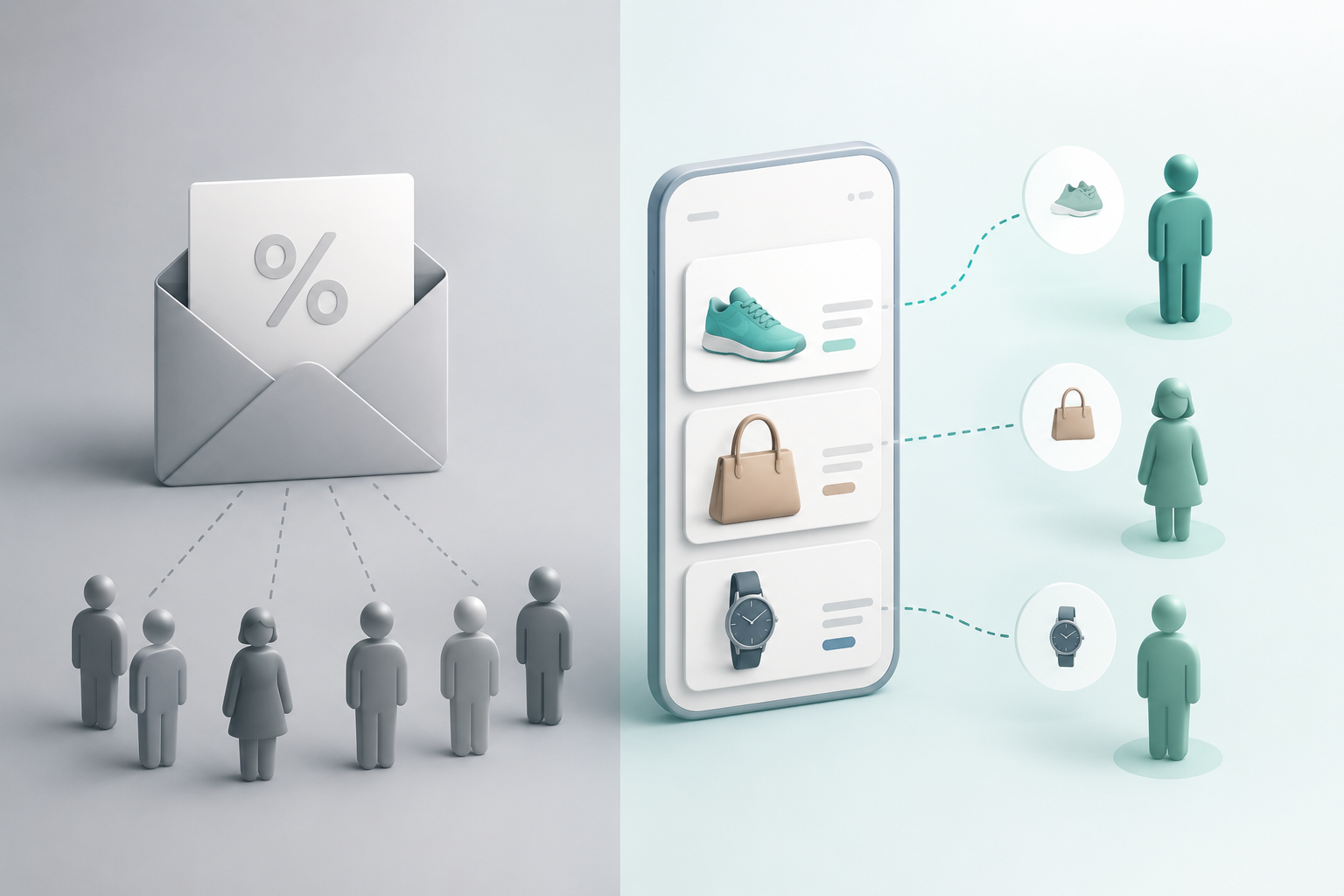

We’ve all received a discount email that had absolutely nothing to do with what we actually wanted to buy.
It gets deleted immediately.
Sometimes it even leads to an unsubscribe because the brand clearly doesn’t understand what we’re interested in.
Meanwhile, a personalized recommendation based on browsing behaviour, past purchases, or products we were already considering? That’s the email we actually click.
That’s the difference between generic promotions and personalized customer journeys and the data increasingly shows that relevance wins.
Brands investing in personalization are seeing stronger engagement, higher conversion rates, better retention, and greater customer loyalty. In a market where consumers are overwhelmed with choices and marketing messages, relevance has become one of the most valuable competitive advantages a business can build.
Why Generic Promotions Fall Flat
For years, many brands relied on the same playbook:
Send a sitewide discount to the entire email list and hope for results.
The problem is that broad promotions rarely speak directly to individual customer needs.
Some customers would have purchased anyway.
Others are not motivated by discounts at all.
Many simply ignore the message because it feels irrelevant.
Over time, constant promotions can also create a dangerous cycle. Customers become conditioned to wait for sales instead of purchasing at full price, reducing perceived brand value and putting pressure on margins.
Eventually, brands end up competing on discounts instead of differentiation.
In today’s environment, that strategy is becoming less effective.
Consumers are exposed to thousands of marketing messages every day. Generic campaigns blend into the background. Relevance stands out.
What Personalized Journeys Actually Do
Personalization shifts marketing from broadcasting to understanding.
Instead of treating every customer the same, brands tailor experiences based on behaviour, interests, purchase history, engagement patterns, and intent signals.
That personalization can take many forms:
- Product recommendations based on browsing history
- Replenishment reminders
- Dynamic email content
- Personalized bundles
- Loyalty-based offers
- Educational content tied to customer interests
- Automated post-purchase journeys
- AI-powered recommendations and predictive targeting
The goal is not simply to sell more products. It is to create experiences that feel useful, timely, and relevant.
When customers feel understood, they engage differently. They are more likely to click, purchase, return, and build long-term trust with the brand.
The Numbers Tell the Story
The shift toward personalization is not just anecdotal. The performance impact is measurable.
According to research from McKinsey, companies that excel at personalization generate significantly more revenue from marketing activities and improve customer acquisition efficiency. Consumers increasingly expect personalized interactions and become frustrated when those experiences feel disconnected or generic.
HubSpot research also shows that personalized calls-to-action and segmented campaigns consistently outperform broad messaging strategies across engagement metrics.
Some of the most common benefits brands see include:
- Higher conversion rates
- Increased customer lifetime value
- Better retention and repeat purchase behaviour
- Lower cart abandonment rates
- Stronger email engagement
- Improved loyalty and advocacy
Even small improvements compound quickly at scale.
For example, increasing conversion rates from 2.0% to 2.4% may appear incremental, but across thousands of transactions, that improvement can represent substantial revenue growth.
Why This Shift Matters More Than Ever
Consumer expectations have changed.
Customers no longer want to feel like a number in a database. They expect brands to recognize their preferences, understand their needs, and communicate in ways that feel relevant.
At the same time, the technology powering personalization has become dramatically more accessible.
Businesses no longer need enterprise-level budgets to build sophisticated customer journeys. Platforms like Klaviyo, Shopify, customer data platforms (CDPs), marketing automation tools, and AI-powered recommendation engines have made advanced personalization achievable for brands of all sizes.
According to Deloitte, the majority of marketers now view personalization as critical to achieving business goals, yet relatively few organizations believe they are executing it effectively.
That gap represents a major opportunity.
Brands that invest early in relevance and customer understanding are building advantages that become increasingly difficult for competitors to replicate.
The Cost of Staying Generic
The biggest risk today is not investing in personalization.
Every month a business continues relying solely on broad promotions is another month competitors are strengthening customer relationships, improving retention, and increasing efficiency through better targeting and automation.
The opportunity cost adds up quickly.
Customers who feel understood:
- Spend more over time
- Leave stronger reviews
- Refer friends and family
- Engage more frequently
- Stay loyal longer
That long-term value is far greater than a temporary sales spike driven by another discount code.
AI Is Accelerating the Need for Relevance
The rise of AI is also changing customer expectations around personalization.
As highlighted in recent Harvard Business Review discussions around AI and modern work, automation is not reducing the demand for better customer experiences. It is intensifying it.
Consumers now expect faster, smarter, and more contextual interactions across every touchpoint.
AI-powered personalization allows brands to scale relevance in ways that were previously impossible:
- Predictive recommendations
- Real-time segmentation
- Dynamic content generation
- Behaviour-triggered messaging
- Smarter product discovery
- Personalized search experiences
The brands using AI effectively are not simply automating promotions. They are creating more individualized customer journeys at scale.
Promotions Are Still Useful
Discounts will always have a place in marketing.
But promotions alone are no longer enough to build sustainable growth.
Personalization creates something far more valuable: relevance.
And relevance drives stronger engagement, better customer experiences, higher retention, and long-term loyalty.
The brands winning today are not necessarily the ones offering the biggest discounts. They are the ones making customers feel understood.
Promotions are a tactic.
Personalization is a strategy.
And increasingly, relevance is becoming the true driver of ROI.